














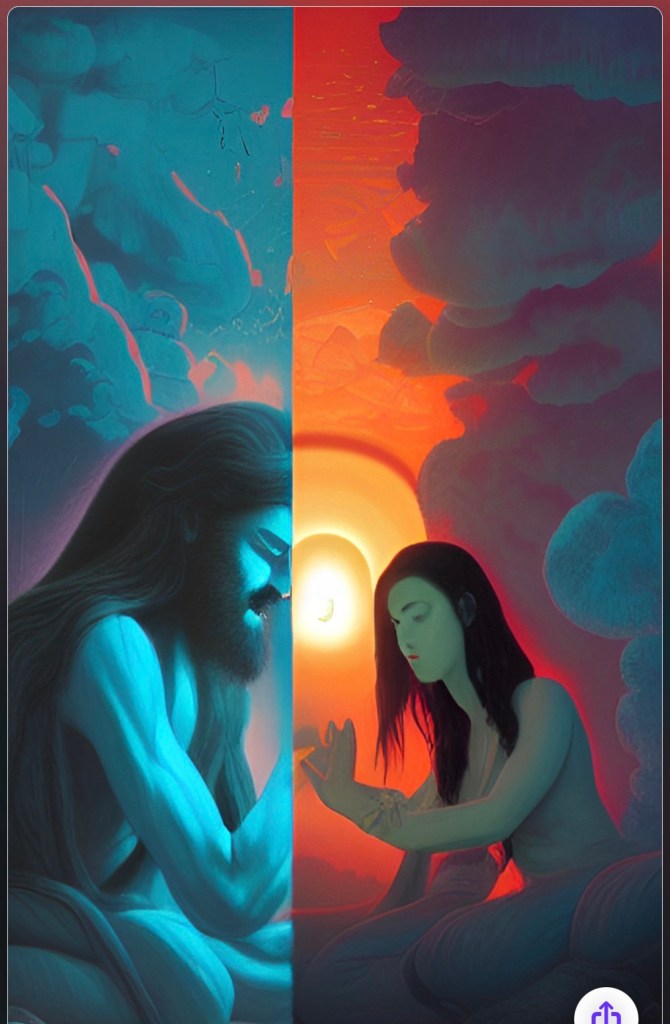
I. The Persona
In New York City, Maya lived easily within what Carl Jung called the persona—the social mask worn to navigate the world.
Behind the bar she was lively, charming, effortlessly attentive. Men came not only for drinks but for the experience of being seen by her. Maya knew how to perform the role perfectly.
Her laughter was quick.
Her eyes attentive.
Her gestures warm.
And the mask worked.
Money flowed easily in tips. Invitations followed naturally. Some evenings ended in expensive restaurants, others in beds that felt strangely anonymous the next morning.
Yet the persona has a hidden cost.
When a person lives too long inside a role, something beneath it begins to stir.
Late at night, walking home through the city streets, Maya sometimes felt a peculiar sensation—as if she had stepped off a stage after a performance and discovered the theater empty.
Who was she when no one was watching?
The question lingered like an unfinished sentence.
⸻
II. The Call of the Unconscious
Her visits to psychics were not really about belief. They were attempts to hear a voice that seemed to whisper from somewhere deeper within her.
The unconscious rarely speaks clearly.
Instead it sends symbols.
Dreams.
Strange encounters.
Unusual impulses.
One evening, a traveler from India sat at her bar drinking tea.
His presence felt oddly calm, like a still pool in the middle of rushing water.
He spoke to her about tantra—not as indulgence, but as a path of awareness that recognizes the energies of the human psyche rather than repressing them.
“You are searching,” he told her.
Maya felt a sudden uneasiness.
It was the feeling of someone who realizes that a stranger has spoken a hidden truth.
Within weeks she had decided to travel to India.
Later she would wonder whether the decision had truly been hers—or whether something deeper had begun guiding her.
⸻
III. The Journey Upward
The journey from Delhi into the Himalayas unfolded like a symbolic ascent.
The bus climbed narrow roads carved into mountainsides. Rivers thundered below, ancient and indifferent to human plans.
The passengers spoke little.
The landscape demanded attention.
There were moments of breathtaking beauty—a stretch of flat valley after hours of dizzying curves, a waterfall casting brief rainbows into the air.
But there was also danger: blind turns, cliffs, narrow bridges suspended over impossible depths.
Psychologically, Maya was entering unfamiliar terrain.
In Jungian terms, she was leaving the safe structures of the conscious mind and approaching the deeper layers of the psyche.
The destination was Gangotri, source of the sacred river.
Symbolically, she was traveling toward the source of herself.
⸻
IV. The Hermit
Beyond Gangotri, along a trail leading toward the glacier called Gomukh, lived a hermit known as Baba Shivshambhu.
Maya expected mysticism.
Instead she found something simpler.
The old man listened more than he spoke.
When she described her life in New York—its excitement, its pleasures, its strange emptiness—he nodded quietly.
“You have lived through the persona,” he said.
“And now the psyche asks for something else.”
“What?” Maya asked.
“The encounter with what you have not yet seen.”
⸻
V. The Shadow
Inside the cave stood a small statue of Kali.
Maya recoiled slightly when she first saw it.
The goddess appeared fierce: dark skin, wild hair, necklace of skulls, tongue extended. One foot rested on the still body of Shiva.
“She looks terrifying,” Maya said.
Baba Shivshambhu smiled.
“That is because you see her with the conscious mind.”
“In psychological language,” he continued, “she represents what Carl Jung called the Shadow.”
Maya frowned.
“The shadow is everything we refuse to see in ourselves,” he explained.
“Desire. Rage. Fear. Power. Instinct.”
“Civilization teaches us to hide these forces behind polite masks.”
He gestured toward the statue.
“But the psyche never destroys them.”
“It only buries them.”
⸻
VI. Kali as Transformation
Over the following weeks Maya began meditation and ritual practices centered on the image of Kali.
At first the symbolism disturbed her.
The severed heads.
The skulls.
The wild, ecstatic expression.
But Baba Shivshambhu explained the deeper meaning.
“Kali destroys illusions,” he said.
“The skulls represent identities that must fall away.”
“Bartender. Lover. Seductress. Seeker.”
“All are masks.”
Maya slowly realized something unsettling.
Her entire life in New York had been organized around the need to be seen in a certain way.
Attractive.
Desirable.
Interesting.
But beneath that persona lay emotions she had rarely acknowledged.
Loneliness.
Anger.
Fear of being insignificant.
These were the forces the psyche had hidden in shadow.
And Kali demanded that they be faced.
⸻
VII. The Encounter
One evening during meditation Maya experienced a powerful psychological shift.
Memories rose vividly before her mind.
Faces of men she had known. Nights filled with laughter and alcohol.
But this time she saw those memories differently.
She saw how often she had performed for approval.
How frequently she had confused attention with intimacy.
The realization was uncomfortable—almost painful.
Yet beneath the discomfort lay something unexpected.
Relief.
For the first time she felt she was seeing herself honestly.
Baba Shivshambhu later explained:
“When the Shadow is faced, the psyche begins to reorganize.”
“This is the beginning of individuation.”
The word came directly from the psychology of Carl Jung.
Individuation meant becoming a whole person rather than a collection of roles.
⸻
VIII. Shiva and Awareness
The statue showed Kali standing upon Shiva.
Maya eventually asked why.
Baba Shivshambhu answered:
“Kali is the wild energy of the psyche.”
“Shiva is pure awareness.”
“When awareness meets the shadow, transformation occurs.”
Without awareness, instinct can become destructive.
Without instinct, awareness becomes sterile.
Tantra sought the union of both.
Psychologically, it meant allowing unconscious energies to emerge while remaining conscious of them.
⸻
IX. The Return
Eventually Maya left the mountains.
Psychological transformations rarely feel dramatic in the moment. They unfold quietly.
Back in New York, life looked exactly the same.
The bar.
The music.
The men who flirted across the counter.
But something subtle had shifted inside her.
She could now observe her impulses rather than being carried away by them.
Attention still felt pleasant.
But it no longer defined her.
The persona had become transparent.
⸻
X. The Dream
The dream came months after Maya returned to New York.
She had resumed working at the bar, but something inside her had changed. The city still pulsed with its familiar rhythms—laughter, music, flirtation—but Maya experienced it as if from a deeper center of stillness.
One night, after a long shift, she fell asleep almost immediately.
And the dream began.
⸻
The Mountain of Night
Maya found herself standing once again in the Himalayas.
But this time the landscape was vast beyond comprehension.
The mountains rose like silent guardians beneath a sky filled with brilliant stars. The glacier of Gomukh glowed faintly in moonlight, and from its icy mouth the river Ganges flowed like liquid silver through the valley.
Yet something was different.
The river was flowing upward.
Instead of descending into the world, the water moved toward the sky.
Maya felt neither surprise nor fear.
Dreams obey deeper laws.
⸻
The Circle of Masks
Around her feet lay dozens of masks.
Some were familiar.
The smiling bartender.
The flirtatious companion.
The lonely seeker visiting psychics in dim Manhattan apartments.
Other masks represented emotions she had rarely admitted.
Anger.
Jealousy.
Pride.
Fear.
She realized these were the fragments of her identity.
The many selves she had worn throughout her life.
A wind rose suddenly across the valley.
The masks lifted gently from the ground and began circling around her like leaves caught in a spiral.
At the center of the spiral, Maya stood very still.
Then the dancer appeared.
⸻
The Goddess
Out of the darkness stepped Kali.
Her presence filled the valley with immense power.
Her hair moved like storm clouds. Around her neck hung the garland of skulls. In one hand she held a sword, in another a lotus flower.
But Maya noticed something new.
The skulls were not trophies of violence.
They were symbols of identities that had been shed.
Each skull was a life that had been lived and released.
Kali began to dance.
The spiral of masks moved faster around Maya.
One by one the goddess touched them.
Each mask dissolved instantly into light.
The bartender vanished.
The seductress vanished.
Even the seeker vanished.
The dance continued until nothing remained.
Only Maya stood there beneath the vast sky.
And she felt suddenly naked—not physically, but psychologically.
All the stories she had told herself were gone.
For a moment she felt panic.
Who was she without them?
Then the ground trembled gently.
⸻
Shiva
Behind the dancing goddess lay a still figure.
It was Shiva.
His body was calm and unmoving, eyes closed in meditation.
Unlike Kali’s wild motion, Shiva radiated perfect stillness.
Maya suddenly understood the symbolism.
Kali was the energy of transformation—the unconscious forces that break apart illusions.
Shiva was awareness itself—the silent witness beneath every experience.
Kali continued her dance until she finally stepped upon Shiva’s chest.
The moment her foot touched him, something extraordinary happened.
The valley filled with light.
Kali stopped moving.
Shiva opened his eyes.
And for the first time Maya saw them looking directly at each other.
Energy and awareness.
Motion and stillness.
Shadow and consciousness.
⸻
The Union
The two figures slowly merged.
Kali’s fierce expression softened. Shiva’s stillness gained warmth.
They became a single radiant presence standing before Maya.
Not male.
Not female.
Not terrifying.
Not peaceful.
But complete.
At that moment Maya felt something shift inside her.
All the fragmented parts of herself—the desires she had hidden, the identities she had worn, the fears she had carried—suddenly aligned around a quiet center.
She realized something profound.
The goal had never been to destroy the shadow.
It had been to recognize and integrate it.
The fierce goddess and the silent god were not external beings.
They were symbols of forces within her own psyche.
Exactly as Carl Jung had described.
⸻
The River Reversed
The glowing presence pointed toward the river.
Maya noticed that the water was no longer flowing upward.
It now flowed naturally down the mountain.
Calm.
Balanced.
Effortless.
She understood the meaning without words.
Before, her life energy had been scattered—chasing approval, attention, excitement.
Now it could flow naturally through her life without distortion.
The dream began to fade.
But just before waking, Maya heard a voice that seemed to come from everywhere at once.
“Nothing was ever separate.”
⸻
Awakening
When Maya awoke in her small New York apartment, the early morning light filtered through the window.
The city was beginning another day.
Traffic hummed softly in the distance.
For several moments she lay still, feeling a quiet sense of completeness.
The dream felt less like imagination and more like revelation.
In the language of Carl Jung, the psyche had completed a stage of individuation.
The shadow had been confronted.
The unconscious energies represented by Kali had been integrated with the awareness symbolized by Shiva.
Maya rose from bed and looked out at the waking city.
For the first time in years, she felt no need to perform.
No need to search.
The journey had not ended.
But something fundamental had changed.
She had finally begun to live from the center of her own psyche.
And that center was still.